
Studio journal · Tech updates
Google Gemini 4 Argon: A Major Step Forward for AI-Assisted Software Development?
What Google's Gemini 4 Argon means for independent developers, from early coding results and prototyping to pricing, reliability and human oversight.
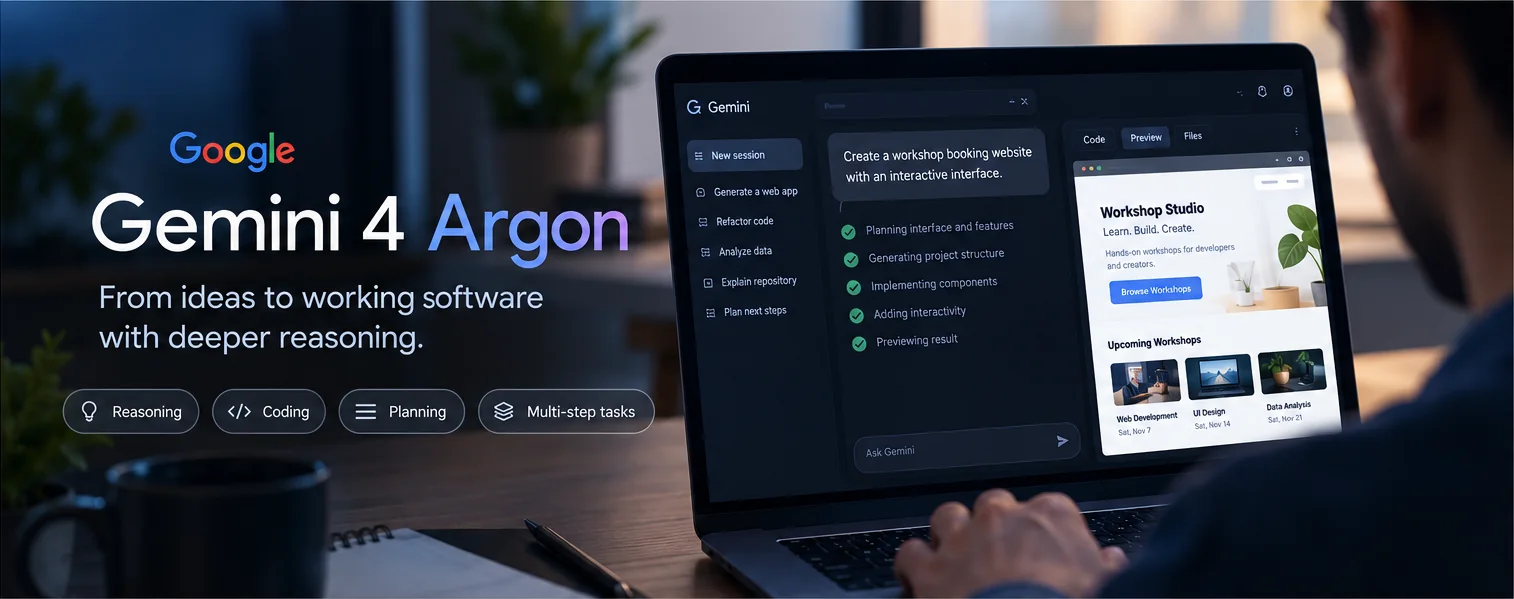
Google’s AI model promises stronger reasoning, improved coding capabilities and more effective handling of complex development tasks. Early reports are encouraging, but how much of this progress translates into practical benefits for independent developers?
A new contender in AI-assisted development
On 13 October 2026, Google expanded access to Gemini 4 Argon, an AI model designed for complex reasoning, software engineering and multi-step problem-solving.
The model is offered through Google’s developer ecosystem, with availability dependent on platform and eligibility. Its ambitions extend beyond answering questions or producing isolated code snippets. Argon is designed to support longer workflows involving analysis, planning and implementation.
For independent developers, the question is straightforward: can advanced AI systems meaningfully reduce the complexity of building and maintaining applications? Early reports suggest potential, but important limitations remain.
What makes Gemini 4 Argon different?
One prominent feature is a context window of approximately one million tokens, allowing the model to process extensive source code, documentation and project requirements. Google also describes adjustable reasoning settings for tasks with different complexity levels.
This matters because real applications rarely consist of one source file. Even relatively simple software involves interconnected components, external dependencies, platform requirements and build configurations. A change in one area can affect several others.
The capacity to consider more of a project at once may help developers identify such connections. However, a large context window does not guarantee accurate understanding, and generated changes still require review and testing.
Google’s internal results show promising improvements
Google has reported encouraging changes in its internal engineering workflows using Gemini 4 Argon through Antigravity. According to its published account, agentic code submissions increased by more than 35%, while post-submission rollbacks fell by approximately 30% during the reported observation period.
Google has also described uses involving investigation of performance issues, legacy systems and complex maintenance work. Such tasks are especially interesting because they require understanding interactions between code, configuration and software behavior rather than generating a function in isolation.
These figures should be interpreted carefully. They are Google-reported internal results, not independently established productivity gains for all developers. Project size, developer experience, tools and review practices can all influence outcomes.
What independent reviewers found
An independent hands-on evaluation by Analytics Vidhya examined Gemini 4 Argon in practical tasks including website prototyping, numerical analysis and document reconciliation. The outcomes were encouraging, but they also revealed why human verification remains necessary.

Website prototyping
In one test, a reviewer supplied written requirements for an interactive workshop-booking website. The model, used with Google’s Canvas environment, generated a functional prototype with booking inputs and interactive elements.
For smaller development teams, creating a usable starting point from a written brief can accelerate early experimentation. A prototype is not the same as production-ready software, however. Accessibility, input validation, security, persistent data handling and cross-device behavior still need attention.
Numerical analysis and reasoning
In a dashboard analysis task, the model examined underlying conversion data rather than simply repeating a conclusion suggested by the headline metrics. Its calculations matched the reviewer’s checks, and it recognized limits on what the evidence could establish.
That is a potentially valuable capability: an assistant should be able to question assumptions, not merely reinforce them. The result nevertheless describes one evaluation, not a guarantee of mathematical correctness in every situation.
Document reconciliation
The reviewer also tested conflicting project documents. Argon identified supported claims and distinguished approved decisions from drafts in the supplied material. Yet the generated summary included an additional unsupported statement.
This contrast matters. A model can perform the core analytical task well and still insert a factual error into its final explanation.
The remaining problem: AI can still be wrong
Advanced reasoning does not eliminate hallucinations, incorrect assumptions or fragile code. A seemingly persuasive fix may fail on unusual inputs, interact badly with another component or rely on an API that behaves differently in production.
The risks increase when agents receive permission to perform multi-step actions. Code review, automated tests, permission boundaries and reproducible builds remain essential. AI should reinforce engineering discipline rather than replace it.
What about pricing?
Google’s published introductory Gemini 4 Argon API pricing lists $2 per million input tokens and $10 per million output tokens, with standard rates of $4 and $20, respectively, scheduled from 1 December 2026. Reasoning tokens are included in output-token billing, which can make longer tasks more expensive than the visible final answer suggests.
These figures should be rechecked against Google’s current pricing documentation immediately before publication. Actual costs depend on token usage, task complexity, repeated attempts and verification.
For independent developers, the most powerful model is not automatically the most economical choice. A capable model might justify its cost for difficult debugging or refactoring, while smaller alternatives may be appropriate for routine tasks.
What this means for independent developers
An independent developer may handle interface design, implementation, debugging, testing, documentation and release management alone. AI assistants can reduce the effort involved in some of these tasks, but they cannot remove responsibility for the finished product.
Consider an image-resizing application. Its purpose sounds simple: open an image, adjust dimensions and export a file. In practice, the implementation must account for memory limits, aspect ratios, output encoding, large files, permissions and unexpected inputs.
AI may generate much of the initial implementation. The more difficult work is ensuring that the application behaves reliably across real devices and edge cases. Models capable of reasoning across multiple components may help with that work, provided their recommendations are inspected and tested.
What developers should watch next
Reliability: Can agents consistently make correct changes across multiple files and dependencies?
Maintainability: Is the resulting code understandable and easy to modify later?
Cost efficiency: Do better outcomes justify the extra reasoning and token usage?
Security: Can developers tightly control file access, commands and external services?
Oversight: Can a developer inspect, reject or reverse proposed changes before they become consequential?
Sanat Utility Studio perspective
At Sanat Utility Studio, we approach AI development tools from the standpoint of building practical software with limited time and resources. Developing an application means balancing technical complexity, cost, usability and reliability. The number of lines of code generated is not a useful measure of quality by itself.
Gemini 4 Argon appears to represent meaningful progress toward assistants that can handle longer and more demanding development workflows. Still, early demonstrations and company-reported metrics should be understood as evidence of potential, not proof of universal reliability.
The most useful approach for small development teams is likely to combine AI-assisted implementation with careful human decisions, review and testing.
The future of AI-assisted programming should not be measured by how much code a model produces. It should be measured by how reliably that code becomes useful, maintainable software.
Sources and further reading
- Google: Gemini 4 Argon is now available for developers, 13 October 2026.
- Google Antigravity: Gemini 4 Argon in Google Antigravity, internal engineering results.
- Google AI for Developers: Gemini model documentation, specifications and pricing.
- Analytics Vidhya: Gemini 4 Argon hands-on review, 14 October 2026.
Editorial methodology
This Tech Update draws on publicly available documentation, company-reported engineering results and third-party hands-on evaluations. Sanat Utility Studio has not performed its own benchmarks of Gemini 4 Argon. Performance claims are attributed to their original sources, and commentary on independent software development is editorial analysis. The illustrations are conceptual, not product screenshots. This article is not sponsored by Google.